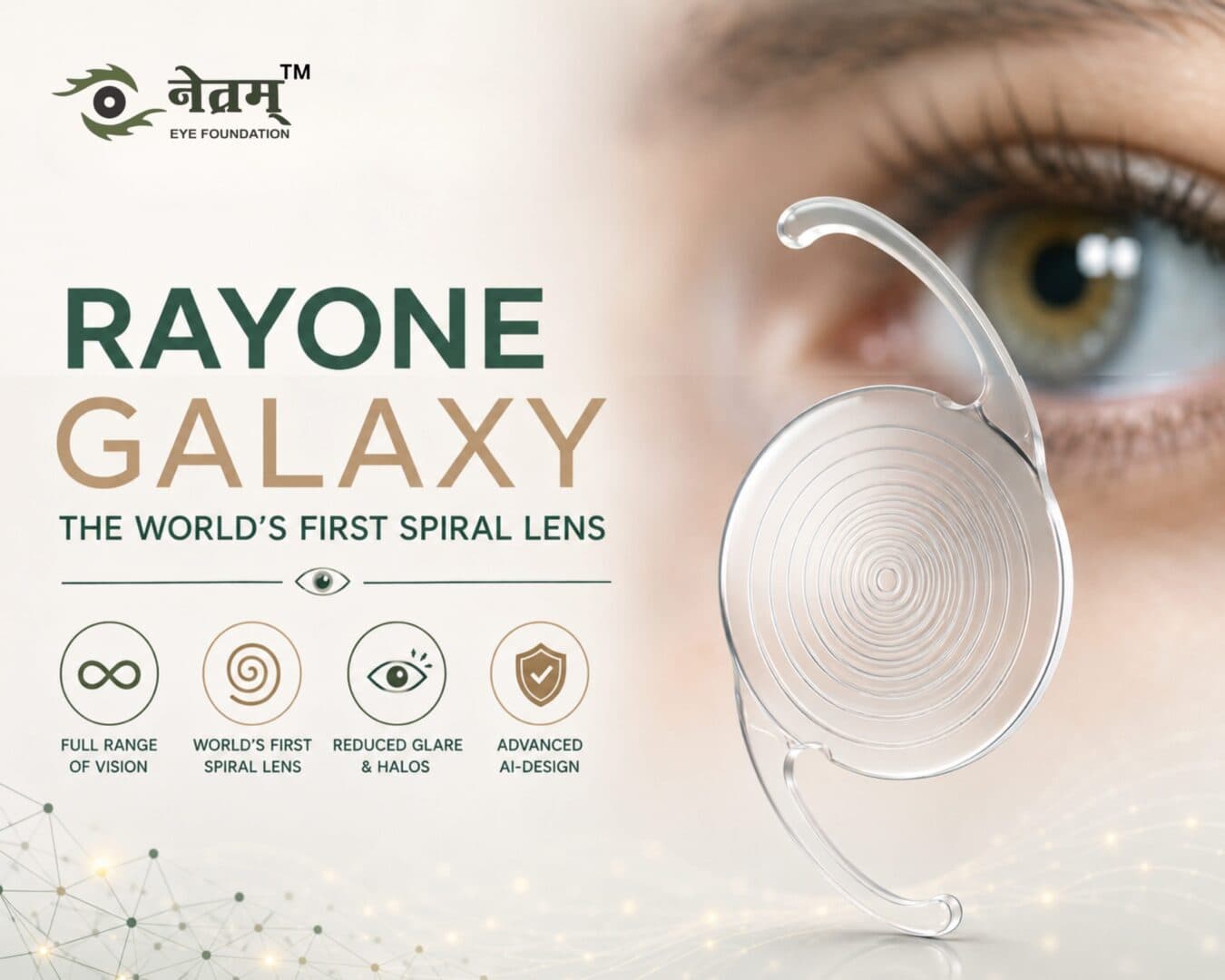
RayOne Galaxy IOL in Delhi: The World’s First Spiral Lens, Explained
When you have cataract surgery, the cloudy natural lens is replaced with an artificial intraocular lens (IOL) — and the lens you choose largely determines how well you’ll see afterward, and whether you’ll still need glasses. Premium “full range of vision” lenses aim to give clear sight at all distances, but they have traditionally involved a trade-off: better near vision often came with more night-time glare and halos. The RayOne Galaxy IOL, launched by Rayner as the world’s first spiral IOL, is designed to challenge that trade-off. At Netram Eye Foundation in Greater Kailash, Delhi, lens selection is matched to each patient’s eyes. This guide explains what the RayOne Galaxy is, how it works, and what the early evidence shows. It is for information only and not a substitute for a consultation.
What Is the RayOne Galaxy?
The RayOne Galaxy is a preloaded, presbyopia-correcting intraocular lens made by Rayner — the UK company that, with Sir Harold Ridley, implanted the world’s very first IOL in 1949. Unveiled at the European Society of Cataract and Refractive Surgeons (ESCRS) congress in 2024 and fully released in 2025, it introduces an entirely new optical concept: a spiral-shaped optic.
Two things make it notable:
- It is the first IOL to use a spiral optic design, developed in collaboration with Brazilian ophthalmologist Dr João Lyra.
- Its design was refined using a proprietary artificial intelligence engine trained on patient outcomes — one of the first real-world examples of AI shaping an implantable lens.
It comes fully preloaded in Rayner’s single-use RayOne injector and is available in toric versions (RayOne Galaxy Toric) for patients who also have astigmatism.
The Core Innovation: A Non-Diffractive Spiral Optic
To understand why the spiral design matters, it helps to know how most premium lenses work.
Diffractive multifocal and trifocal lenses create multiple focal points (distance, intermediate, near) by splitting incoming light. This delivers a range of vision, but splitting light has two side effects: a small amount of light is lost, and many patients notice halos and glare around lights at night (a phenomenon called dysphotopsia).
The RayOne Galaxy takes a different approach. Its spiral optic is non-diffractive — instead of splitting light into separate focal points, the continuous spiral surface is designed to provide a smooth, continuous range of focus. According to Rayner, this delivers a continuous full range of vision with minimised dysphotopsia and 0% loss of transmitted light. In other words, the goal is the spectacle independence of a multifocal lens with night vision closer to that of a simpler lens.
(Note: “0% light loss” and “minimised dysphotopsia” are the manufacturer’s design claims; independent long-term data is still accumulating — see the evidence section below.)
Key Features at a Glance
- Full range of vision — near, intermediate, and distance, aiming to reduce dependence on glasses
- Non-diffractive spiral optic — designed to minimise glare and halos
- Fully preloaded — supplied ready-to-use in the RayOne injector, supporting a smooth, controlled implantation
- Toric option — corrects astigmatism alongside presbyopia
- Rayacryl material — Rayner’s single-piece hydrophilic acrylic lens material
- AI-refined design — optic shape optimised using patient-outcome data
How It Compares to Other Premium Lenses
| Lens type | How it creates range of vision | Night glare/halos | Light efficiency |
| Monofocal | Single focus (usually distance); glasses needed for near | Minimal | Full |
| Enhanced monofocal / EDOF | Extended single focus; some intermediate vision | Low | High |
| Diffractive trifocal | Splits light into distance, intermediate, near | More likely | Some light lost |
| Spiral (RayOne Galaxy) | Continuous non-diffractive spiral optic | Reduced (manufacturer claim) | 0% light loss (manufacturer claim) |
No lens is perfect for everyone — the right choice depends on your eyes, lifestyle, and visual priorities.
What the Evidence Shows So Far
As a newly launched lens, the RayOne Galaxy’s evidence base is early but encouraging, and it is worth reading honestly:
- A pre-launch clinical evaluation involved ten leading surgeons across ten countries, with more than 180 eyes treated and outcomes collected at one and three months.
- Rayner’s interim data reported a full range of vision without the wave-like defocus pattern typical of diffractive trifocal lenses, with mean corrected and uncorrected visual acuity at all distances of 0.1 logMAR or better, and a binocular defocus curve maintaining good vision across roughly a 4.0 D range.
- A preclinical study of 30 patients reported that the lens produced a halo size closer to that of an enhanced monofocal lens than a diffractive trifocal — supporting the low-dysphotopsia claim.
- A US clinical study has completed enrolment as part of the regulatory pathway there.
The honest caveat: much of the current data is manufacturer-reported or from early clinical evaluations and conference presentations. Large-scale, long-term, independent peer-reviewed data is still limited simply because the lens is so new. Early results are promising, but longer follow-up will tell the fuller story.
Who Might Be a Good Candidate?
The RayOne Galaxy may suit you if you:
- Are having cataract surgery or refractive lens exchange
- Want to reduce your dependence on glasses for near, intermediate, and distance
- Are concerned about night-time glare and halos and want a full-range lens designed to minimise them
- Have healthy eyes otherwise (no significant retinal or other conditions that limit vision potential)
As with any premium lens, it is not right for everyone — pre-existing eye conditions, certain corneal or retinal issues, and individual visual needs all affect suitability. A thorough evaluation and an honest discussion of expectations (including a possible neural adaptation period and the premium cost) are essential.
The Procedure
Implanting the RayOne Galaxy follows the same steps as modern cataract surgery: the cloudy lens is removed, and the new lens is injected into the lens capsule. Because it is fully preloaded in its injector, the surgeon does not need to manually load the lens, which supports a controlled, efficient implantation. The procedure is typically quick and performed under local (drop) anaesthesia.
RayOne Galaxy at Netram Eye Foundation
Netram Eye Foundation is a super-speciality eye hospital in Greater Kailash II, South Delhi, led by Dr. Anchal Gupta. Our team helps you choose the most appropriate lens for your eyes and lifestyle — from monofocal to premium full-range options — with an honest discussion of benefits, limitations, and cost, rather than a one-size-fits-all package.
Book a cataract and lens consultation at our Greater Kailash centre to discuss your options.
Frequently Asked Questions
What is the RayOne Galaxy IOL? The RayOne Galaxy is the world’s first spiral intraocular lens, made by Rayner. It is a preloaded, presbyopia-correcting lens implanted during cataract surgery or refractive lens exchange, designed to provide a continuous full range of vision with reduced glare and halos.
What makes the spiral IOL different from a multifocal lens? Traditional diffractive multifocal lenses split light into separate focal points, which can cause halos and glare. The RayOne Galaxy’s spiral optic is non-diffractive and, according to the manufacturer, provides a continuous range of vision with minimised dysphotopsia and no loss of transmitted light.
Is the RayOne Galaxy good for night vision? Its design specifically aims to reduce night-time glare and halos. Early manufacturer data reported halo sizes closer to an enhanced monofocal lens than a diffractive trifocal, though longer-term independent data is still developing.
Does the RayOne Galaxy correct astigmatism? Yes. It is available in a toric version (RayOne Galaxy Toric) that corrects astigmatism along with providing a full range of vision.
Is the RayOne Galaxy proven and safe? It launched in 2024–2025 after clinical evaluation across multiple countries, with encouraging early results. As a new lens, its long-term, large-scale independent evidence base is still accumulating. Your surgeon can discuss whether it is appropriate for you.
Who should not get the RayOne Galaxy? Patients with certain retinal, corneal, or other eye conditions, or particular visual needs, may be better suited to a different lens. Suitability is determined by a full eye evaluation.
References (verify and hyperlink before publishing)
- Rayner. RayOne Galaxy: world’s first spiral IOL designed with AI — launch announcement, ESCRS 2024.
- Rayner. Full commercial release of RayOne Galaxy and RayOne Galaxy Toric (interim multicentre data, January 2025).
- Coverage and interim clinical findings: Ophthalmology Times / Optometry Times / Eyewire+ reports, 2024–2025.
- Spiral-shaped IOL optical concept, Optica, 2024 (foundational spiral multifocal research).
Medically reviewed by Dr Anchal Gupta, Senior Eye Surgeon, Netram Eye Foundation. This article is for general information and is not a substitute for a personalised consultation with a qualified ophthalmologist. Performance claims attributed to the manufacturer reflect company-reported data; independent long-term evidence continues to develop.