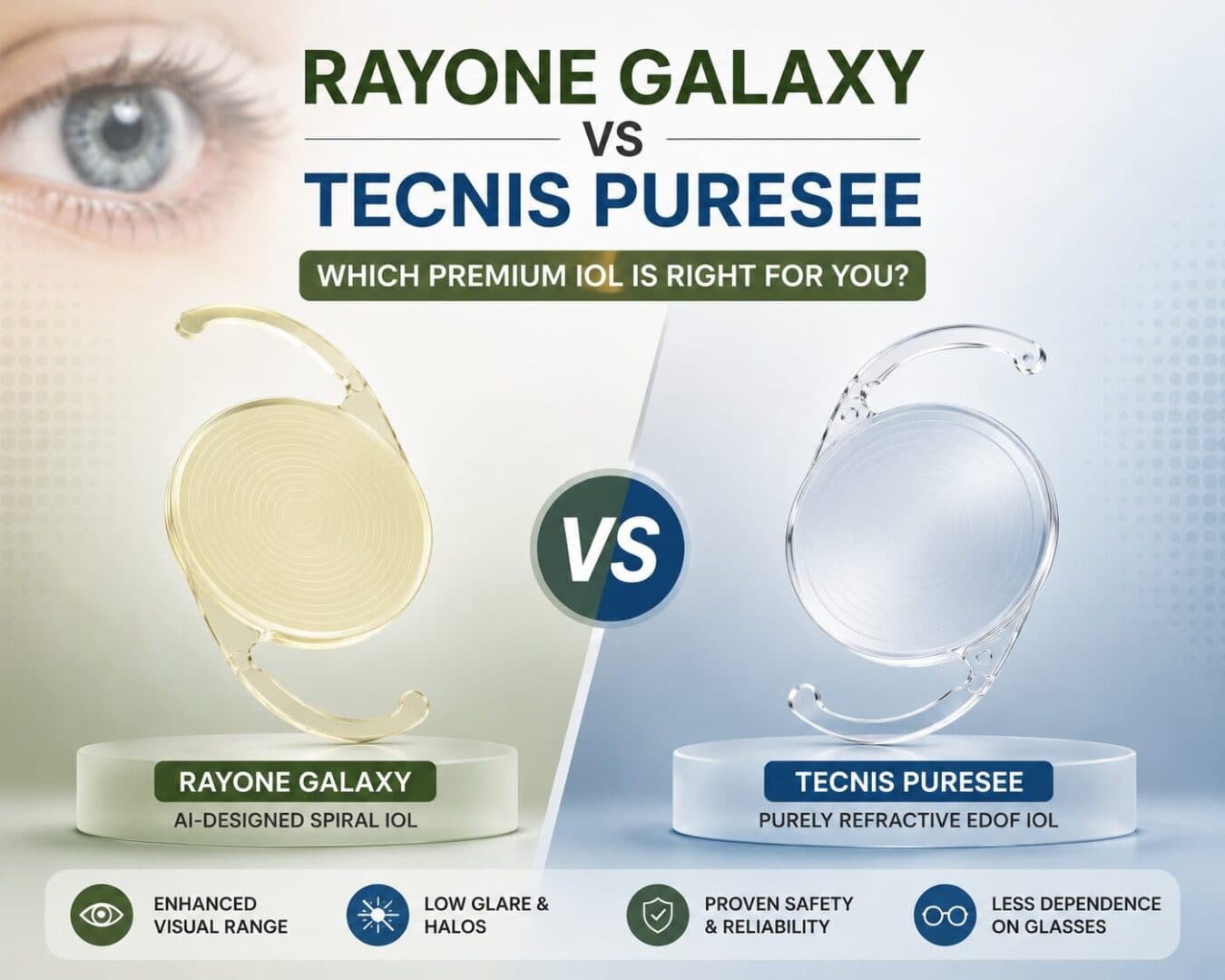
Galaxy Rayner vs. Tecnis PureSee: Which Premium IOL Is Right for You?
When you’re facing cataract surgery or considering a lens exchange to correct presbyopia, the choice of intraocular lens (IOL) is one of the most critical decisions you’ll make. Two of the most talked-about options in 2025 are the Rayner RayOne Galaxy—the world’s first AI-designed spiral lens—and the Johnson & Johnson Tecnis PureSee—a purely refractive extended depth-of-focus (EDOF) lens that’s generating excitement worldwide. Understanding the differences between these technologies, specifically in the RayOne Galaxy vs Tecnis PureSee debate, can help you make an informed choice for your vision needs.
What Are Premium IOLs and Why Do They Matter?
A premium IOL is an advanced lens implanted during cataract surgery or refractive lens exchange that aims to reduce or eliminate dependence on glasses at multiple distances. Traditional monofocal lenses provide excellent distance vision but require reading glasses for near tasks. Premium lenses bridge this gap using various optical designs—from diffractive rings to refractive power changes and even AI-optimized spirals. By 2050, the number of people over 60 is expected to more than double to 2.1 billion, with cataracts remaining the leading cause of treatable blindness worldwide. Advanced IOL technology is becoming increasingly important for maintaining quality of life as populations age.
Introducing the Rayner RayOne Galaxy
The RayOne Galaxy represents a paradigm shift in IOL design. It’s the first intraocular lens designed using artificial intelligence and features a unique non-diffractive spiral optic. Unlike traditional multifocal lenses that use concentric rings to split light, Galaxy uses a continuous spiral pattern that guides light smoothly across the lens surface.
What Makes Galaxy Unique?
-
AI-Driven Design: Artificial intelligence optimized the spiral pattern to deliver a full range of vision while minimizing common side effects like glare and halos.
-
Pupil-Dependent Performance: An independent optical bench study published in the Journal of Refractive Surgery found that Galaxy exhibits pupil-dependent optical performance. With large pupils, it delivers high optical quality at distance. As the pupil constricts (in bright light or with age), a myopic shift of approximately 0.75D enhances intermediate and near vision.
-
Minimal Dysphotopsia: Surgeons who have implanted the Galaxy report minimal glare and halos. Eric Donnenfeld, MD, who participated in clinical trials, noted that “the glare and halo are minimal. The quality of vision has been excellent, and my patients have been extraordinarily happy.”
-
Full Range of Vision: Galaxy aims to provide continuous vision from distance to near without the distinct “steps” or jumps in vision that some patients experience with traditional multifocals.
Introducing the Tecnis PureSee
The Tecnis PureSee (DEN00V model) is a purely refractive extended depth-of-focus (EDOF) IOL from Johnson & Johnson. Its design philosophy differs from Galaxy in fundamental ways. While Galaxy uses a spiral pattern to create its extended range, PureSee achieves depth of focus through carefully engineered continuous power technology on its posterior surface.
What Makes PureSee Unique?
-
Purely Refractive Design: PureSee avoids diffractive rings entirely. Instead, it features a smooth, continuous change in power across the lens surface—no sharp steps or edges. The largest power change occurs in the central zone of the lens, with power varying from approximately 19.5D at the center up to 23.4D at a radial distance of 0.90mm.
-
Preserved Contrast Sensitivity: Unlike traditional multifocals that split light and reduce contrast, PureSee maintains contrast sensitivity comparable to a monofocal IOL under mesopic (low-light) conditions.
-
Low Dysphotopsia Profile: A randomized controlled trial found that the highest incidence of very/extremely bothersome glare, halos, or starbursts was just 3.4%. Most patients did not perceive or were not bothered by halos or glare.
-
Approximately 2.00 Diopters of Extended Focus: Clinical studies demonstrate PureSee provides a depth of focus of approximately 2.00D, offering functional vision from distance to about 50cm (intermediate range). This is slightly less than the full near focus of Galaxy but with fewer visual side effects.
-
Clinically Available in India: Johnson & Johnson announced the availability of Tecnis PureSee in India, providing surgeons with an advanced option for presbyopia correction.
Head-to-Head Comparison
Here’s how the two lenses compare in key areas. This detailed breakdown of the RayOne Galaxy vs Tecnis PureSee will help you understand their core differences:
Visual Performance
| Parameter | RayOne Galaxy | Tecnis PureSee |
|---|---|---|
| Design Type | AI-designed spiral, non-diffractive | Purely refractive EDOF |
| Depth of Focus | Full range (distance to near) | Approximately 2.00D (distance to intermediate) |
| Near Vision | Superior; 89% achieve spectacle independence at near | Good but limited; near spectacle independence ~40% |
| Distance Vision | Excellent with large pupils | Excellent, comparable to monofocal |
| Contrast Sensitivity | Good | Excellent, comparable to monofocal |
Side Effects and Safety
| Parameter | RayOne Galaxy | Tecnis PureSee |
|---|---|---|
| Halos/Glare | Moderate, similar to PureSee; lower than PanOptix | Low; comparable to monofocal in some studies |
| Halo Intensity | Similar to PureSee | Similar to Galaxy; lower than diffractive trifocals |
Patient Satisfaction
A prospective study comparing Galaxy with PureSee and Alcon Vivity (another EDOF lens) found that while all lenses provided high patient satisfaction, Galaxy ranked highest in spectacle independence at near—89% versus 40% for PureSee. However, PureSee patients typically experience fewer visual disturbances. Both lenses received high satisfaction scores overall.
How They Work Differently
Understanding the underlying science can clarify which lens might suit you. The fundamental difference in the RayOne Galaxy vs Tecnis PureSee comparison lies in their optical design:
-
Galaxy’s Spiral Design: The spiral pattern creates a smooth, continuous focal range from distance to near. The spiral is designed to be pupil-dependent, so smaller pupils in bright light enhance near reading, while larger pupils in dim light prioritize distance vision. This makes it particularly well-suited for patients who want near independence but are willing to accept some halo effects.
-
PureSee’s Refractive Design: PureSee achieves its extended focus through continuous power variation across the lens surface—no rings or edges. The lens features biconvex construction with a proprietary refractive surface on the posterior side. It’s available in powers from +5.0D to +34.0D in 0.5D increments and uses hydrophobic acrylic material with a violet-light filter. In optical bench testing, the lens showed two well-defined foci with a 3.0mm aperture (distance and intermediate at +2.25D), while at 4.5mm aperture, only the distance focus remained prominent.
Real-World Surgical Experience
-
Galaxy: Surgeons report Galaxy is relatively straightforward to implant but recommend careful patient counseling because adaptation to the spiral design and patient expectations are crucial for satisfaction. The lens launched in Europe in late 2024 and has become very popular there. FDA trials are ongoing in the United States.
-
PureSee: The PureSee lens is described as forgiving by surgeons. Francesco Carones, MD, notes the lens “minimizes dysphotopsias even when the refractive outcome is not plano,” meaning it tolerates small amounts of residual astigmatism or refractive error well. A micro-monovision strategy (targeting -0.50D in one eye) can enhance near vision while maintaining excellent distance. The lens is preloaded in the Tecnis Simplicity delivery system for ease of use.
Who Should Choose Which Lens?
Deciding between the RayOne Galaxy vs Tecnis PureSee comes down to your lifestyle and visual priorities.
You Might Choose Galaxy If:
-
Spectacle independence at near is your top priority—you want to read without glasses.
-
You’re comfortable with some potential halo or glare effects.
-
Your eyes are relatively healthy with no significant macular or corneal issues.
-
You want the latest AI-driven lens technology.
-
You understand and accept the pupil-dependent nature of the lens.
You Might Choose PureSee If:
-
Minimizing halos and glare is your top priority—you want a “monofocal-like” visual experience.
-
You’re willing to wear reading glasses for small print or extended near work.
-
You have active night-driving needs and want to minimize dysphotopsias.
-
You prefer a more forgiving lens that tolerates small refractive errors well.
-
You want a well-established EDOF platform with strong clinical data and no compromise on contrast sensitivity.
What Studies Show
Recent presentations at the 2025 ESCRS Congress (43rd Congress of the European Society of Cataract and Refractive Surgeons) provided valuable comparative data. One study evaluating four leading full-range-of-vision IOLs—Galaxy, Clareon PanOptix, Odyssey, and PureSee—examined visual performance and defocus curves across multiple distances. The study included 40 patients (10 per IOL group) and assessed outcomes at 1 week, 1 month, and 3 months post-surgery.
Key takeaways from these and other studies:
-
Galaxy offers superior near uncorrected visual acuity (UNVA) compared to PureSee (0.06±0.2 logMAR vs. 0.30±0.10 logMAR).
-
PureSee and Galaxy produce comparable halo profiles, with both causing lower halo intensity than traditional trifocal lenses.
-
PureSee’s depth of focus increases for smaller pupils (2mm aperture) while its maximum optical quality improves with larger pupils (4.5mm aperture).
-
Galaxy demonstrates a myopic shift of the main focus peak with smaller pupils (approximately 0.75D), which enhances intermediate and near performance in bright conditions.
-
PureSee maintains excellent contrast sensitivity under mesopic conditions, with no compromise compared to monofocal lenses.
Frequently Asked Questions (FAQ)
What is the main difference between the RayOne Galaxy and Tecnis PureSee?
The primary difference in the RayOne Galaxy vs Tecnis PureSee comparison is their design and visual outcome. Galaxy is an AI-designed spiral lens providing a full range of vision from distance to near, while PureSee is a refractive EDOF lens offering distance and intermediate vision with minimal halos and preserved contrast sensitivity. Galaxy excels at near vision, while PureSee prioritizes visual quality.
Which lens is better for night driving?
PureSee is generally preferred for night driving due to its lower halo and glare profile, comparable to a monofocal lens. Galaxy has similar halo levels to PureSee but both are significantly lower than traditional multifocals.
Will I need reading glasses with either lens?
With Galaxy, 89% of patients achieve spectacle independence at near. With PureSee, approximately 40% achieve near independence. Patients preferring PureSee typically accept wearing reading glasses for fine near tasks.
Are both lenses available in India?
The Tecnis PureSee is currently available in India as Johnson & Johnson announced its launch in the market. RayOne Galaxy has launched in Europe and is undergoing clinical trials in the United States; its availability in India may vary.
How do these lenses compare to traditional multifocal lenses?
Both Galaxy and PureSee are designed to minimize the halos and glare that patients often experience with traditional diffractive multifocal lenses. Studies show both produce lower halo intensity than the popular Clareon PanOptix trifocal lens.
What is the recovery time after surgery with these lenses?
Both lenses are implanted during standard cataract or lens exchange surgery. Most patients experience improved vision the same day. The full visual benefit develops over the first few weeks as the brain adapts to the new lens and any post-operative refractive error stabilizes.
Conclusion
The choice between RayOne Galaxy and Tecnis PureSee ultimately depends on your personal priorities. When weighing the RayOne Galaxy vs Tecnis PureSee, consider this:
If your priority is maximal spectacle independence, especially for reading, Galaxy offers superior near vision performance with 89% near spectacle independence—nearly double the rate achieved with PureSee.
If your priority is minimal visual side effects and maintaining contrast sensitivity, PureSee provides an outstanding visual experience with minimal halos and glare while maintaining excellent distance and intermediate vision.
Both lenses represent the cutting edge of IOL technology. Galaxy represents the future of AI-optimized optics, while PureSee builds on the proven foundation of refractive EDOF design. Consulting with your ophthalmologist, considering your lifestyle needs, and understanding your personal tolerance for visual disturbances are essential steps in making the best choice for your eyes.
Take Action Today
If you’re considering cataract surgery or refractive lens exchange, schedule a consultation with an experienced eye surgeon. Discuss which lens aligns with your lifestyle, visual needs, and expectations. The right choice can transform your quality of life and reduce your dependence on glasses for years to come.
Contact Netram Eye Foundation today at +91 9319909455 or (011) 41046655, or visit their website at https://www.netrameyefoundation.com/ to schedule your consultation and explore the best options for your vision.