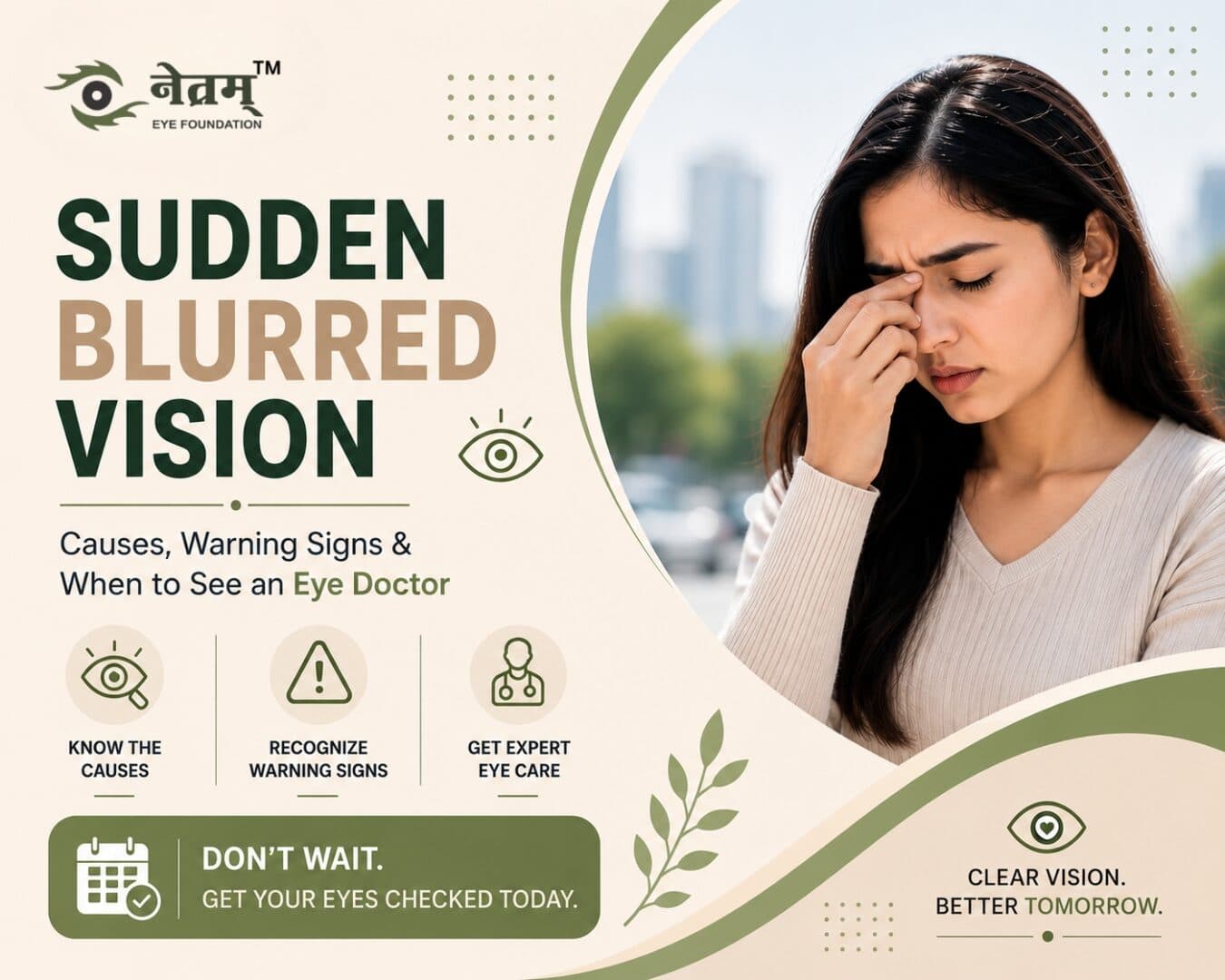
Sudden Blurred Vision: Causes, Warning Signs & When to See an Eye Doctor
Experiencing sudden blurred vision can be alarming. Here is what you need to know about the causes and when to seek immediate help.
Imagine going about your day when suddenly, your vision blurs or darkens like a curtain being drawn across your eye. For many, the instinct is to blink, rub their eyes, or dismiss it as fatigue. However, sudden blurred vision or visual loss is often a critical signal from your body that should never be ignored.
In this guide, we will explore the common and serious causes of sudden visual changes, the crucial warning signs that demand emergency care, and when to seek professional help. At Netram Eye Foundation, we are dedicated to providing world-class eye care and raising awareness about vision health.
Understanding Sudden Blurred Vision: Why Immediate Attention Matters
Sudden blurred vision is defined as a rapid loss of visual acuity, occurring over minutes to hours. According to clinical guidelines, this is a symptom that requires urgent ophthalmic consultation because it can indicate a serious underlying condition that, if left untreated, may lead to permanent vision loss .
The most critical factor is determining the speed of onset. If your vision changes suddenly, it is a red flag. This is distinct from chronic, slowly progressing blurriness (like that caused by cataracts or uncorrected refractive error), which, while also requiring treatment, is typically less urgent .
Common vs. Critical Causes
Common (Non-Emergency) Causes:
Not all blurred vision is an emergency. Common causes include:
- Refractive Errors: A change in your eyeglass prescription.
- Dry Eye Syndrome: Fluctuating blurriness due to inadequate tear production .
- Eye Strain: Often caused by prolonged screen use (digital eye strain).
- Migraine: Visual disturbances (aura) can occur before or during a migraine headache .
Critical (Emergency) Causes:
It is essential to distinguish these mild causes from sight-threatening emergencies. These include:
- Retinal Detachment: The retina pulls away from its normal position.
- Acute Glaucoma: A sudden, dangerous increase in eye pressure.
- Optic Neuritis: Inflammation of the optic nerve.
- Stroke or Transient Ischemic Attack (TIA): A neurological issue affecting the visual pathways .
The Silent Emergency: “Eye Stroke” (Retinal Artery Occlusion)
One of the most critical causes of sudden, painless vision loss is an “eye stroke,” medically known as a retinal artery occlusion (RAO) . This occurs when the main artery supplying blood to the retina becomes blocked, similar to a stroke in the brain .
Why it is dangerous:
Retinal nerve cells are extremely sensitive to a lack of oxygen. The damage can become irreversible in as little as 90 minutes . The condition is painless, which often leads patients to delay seeking help, but this is a grave mistake.
Key Warning Sign:
Transient Ischemic Attack (TIA) or “Mini-Stroke”: Often, an eye stroke is preceded by a temporary episode called a “transient blackout” (amaurosis fugax). This is where vision in one eye suddenly darkens, like a shade being pulled down, and then returns to normal after a few seconds or minutes .
The “90-Minute” Gold Standard
The emergency window to save vision is extremely narrow. Studies indicate that a diagnosis of acute RAO must be made within 4.5 hours of vision loss to consider life-saving treatments like thrombolysis, but the damage begins within minutes . If you experience sudden, painless vision loss, do not wait to see if it gets better. Go to an emergency room or eye hospital immediately.
Other Serious Causes of Sudden Vision Change
While an eye stroke is a vascular emergency, other conditions can cause sudden visual disturbances:
1. Retinal Detachment
- Symptoms: Sudden increase in floaters (spots or strings), flashes of light, and a shadow or curtain moving across your field of vision .
- Action: This is a surgical emergency. Prompt treatment can prevent permanent blindness.
2. Acute Angle-Closure Glaucoma
- Symptoms: Severe eye pain, headache, nausea, vomiting, and seeing halos (rainbow-colored rings) around lights .
- Action: This is a medical emergency requiring immediate pressure-lowering treatment.
3. Vitreous Hemorrhage
- Symptoms: A sudden shower of floaters or a dark red haze over the vision, often painless.
- Action: This indicates bleeding inside the eye, often linked to diabetic retinopathy or trauma, and requires urgent evaluation .
When to See an Eye Doctor: Warning Signs You Should Never Ignore
If you experience any of the following symptoms, seek immediate medical attention—do not wait for a routine appointment:
- Sudden, Painless Vision Loss: Especially if it occurs in one eye.
- A Shadow or Curtain Over Vision: As if something is blocking part of your sight .
- Sudden Increase in Floaters and Flashes: This can be a warning sign of retinal detachment.
- Severe Eye Pain with Nausea and Halos: Likely acute glaucoma .
- Transient Blackouts: If your vision goes black for a few minutes, even if it recovers, it is a sign of a vascular issue (TIA) .
Important Note: You should also seek care for non-sudden but severe blurring that affects your daily life. Approximately 2.2 billion people globally have a vision impairment, and in nearly half of those cases, the condition was preventable or has not yet been treated . Regular checkups can catch these issues early.
The Role of Netram Eye Foundation
At Netram Eye Foundation, we believe in the power of timely intervention and compassionate care. Our mission is to restore vision and provide hope to those in need. Our experienced team, led by experts like Dr. Anchal Gupta, is dedicated to diagnosing and treating a wide range of eye conditions, from routine cataracts to complex emergencies .
Why Choose Us?
- Expertise: We specialize in ophthalmic care, including advanced surgical procedures and management of retinal diseases.
- Community Focus: We are committed to making eye care accessible and are actively involved in community health initiatives .
- Patient-Centered Care: We focus on guiding patients through their journey towards clarity, ensuring they understand their condition and treatment plan .
FAQ
1. Can sudden blurred vision be caused by high blood pressure?
Yes. High blood pressure (hypertension) is a major risk factor for eye stroke (retinal artery occlusion) and other vascular issues in the eye . It can damage the blood vessels in the retina, leading to sudden or gradual vision changes.
2. Why did my vision suddenly get blurry in one eye?
Sudden blurred vision in one eye is often more concerning than in both eyes. It can indicate a problem with the eye itself (like a retinal issue or cataract) or a neurological/vascular event (like an eye stroke or TIA). Seek immediate evaluation .
3. Is sudden blurred vision a sign of a stroke?
Yes. Sudden blurred vision, particularly in one eye or affecting part of the visual field, can be a symptom of a stroke or TIA (ministroke) . Use the FAST acronym for stroke: Face drooping, Arm weakness, Speech difficulty, Time to call emergency services.
4. How do you fix sudden blurry vision?
The treatment depends entirely on the cause. Refractive errors and dry eyes are fixed with glasses or drops. Emergencies like eye strokes require immediate medical intervention (e.g., clot-dissolving medication) and retinal detachments require surgery. Do not attempt to “fix” it yourself—seek professional help immediately .
5. What does a retinal detachment look like?
Retinal detachment often manifests as a sudden increase in floaters (specks), flashes of light, and a dark shadow or “curtain” that moves across your field of vision .
6. Should I go to the ER for blurred vision?
Yes. If your blurred vision came on suddenly, is painless, or is accompanied by severe eye pain, headache, or flashes/floaters, you should go to an emergency room or the nearest eye hospital immediately to prevent permanent damage .
Conclusion
Sudden blurred vision is a symptom that bridges the gap between a minor annoyance and a life-altering emergency. While some causes are benign, the risk of a sight-threatening event like an eye stroke, retinal detachment, or acute glaucoma is too significant to ignore.
Remember the critical rule: Sudden, painless vision loss is an emergency.
Protect your sight by knowing the warning signs and acting quickly. If you have any concerns about your vision, do not hesitate to contact Netram Eye Foundation for expert advice and care. Your vision is priceless—treat it with urgency and respect.
Medically reviewed by Dr. Anchal Gupta, Netram Eye Foundation. This article is for general awareness and is not a substitute for a personal consultation.