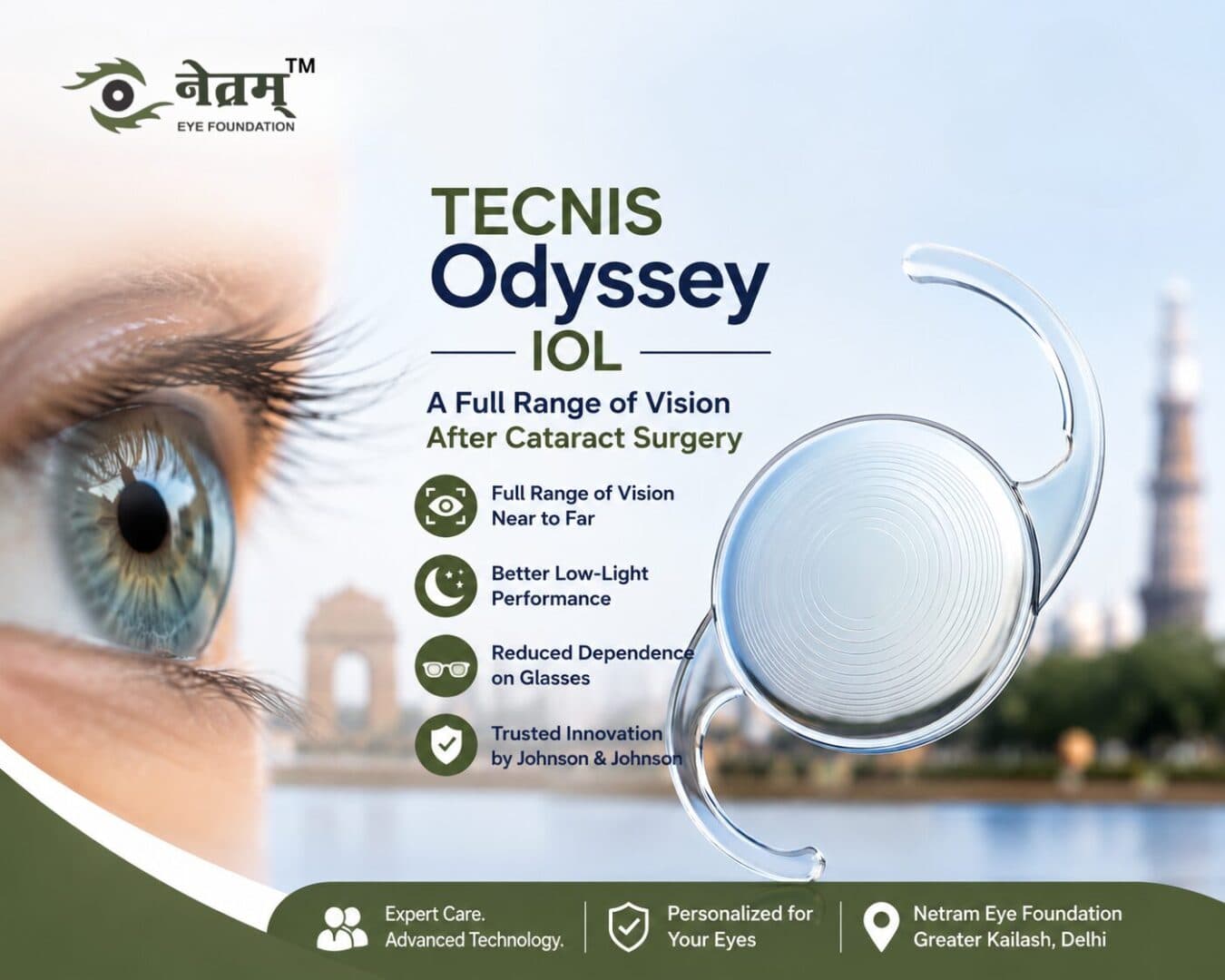
TECNIS Odyssey IOL in Delhi: A Full Range of Vision After Cataract Surgery
Cataract surgery is a once-in-a-lifetime chance to upgrade your vision — and the intraocular lens (IOL) you choose decides how well you’ll see, and how often you’ll reach for glasses, for the rest of your life. The TECNIS Odyssey IOL, Johnson & Johnson’s latest premium lens, belongs to a new category the company calls “full visual range” — designed to give clear, continuous vision from near to far, with strong performance in low light. At Netram Eye Foundation in Greater Kailash, Delhi, lens choice is matched carefully to each patient’s eyes and lifestyle. This guide explains what the TECNIS Odyssey is, how it works, and what the evidence shows. It is for information only and not a substitute for a consultation.
What Is the TECNIS Odyssey IOL?
The TECNIS Odyssey is a next-generation presbyopia-correcting IOL made by Johnson & Johnson Vision and built on the well-established TECNIS platform. Launched in 2024, it has been adopted rapidly — Johnson & Johnson reported it reached over 100,000 implanted eyes within its first year, making it one of the fastest-growing premium lenses on the market. It has received regulatory approval across many regions, including the US, EU, Japan, Canada, Korea, Singapore, Australia, and New Zealand.
Johnson & Johnson classifies it as a “full visual range” (FVR) IOL — its term for a lens intended to deliver seamless vision across the whole range of distances, rather than at a few fixed focal points.
The Core Innovation: A Freeform Diffractive Surface
Most multifocal and trifocal lenses provide vision at distinct focal points (for example, near, intermediate, and far), which can leave subtle “gaps” between those zones.
The TECNIS Odyssey uses a unique freeform diffractive surface engineered to eliminate those gaps, providing — in the manufacturer’s words — continuous, uninterrupted vision at all distances. Importantly, although it is a diffractive lens, Johnson & Johnson reports it achieves over 95% light utilisation, meaning very little light is wasted, which supports image quality and low-light performance. It also incorporates a violet-light filter.
(Note: figures such as “over 95% light utilisation” and the comparisons to other lenses below are Johnson & Johnson’s reported data — see the evidence section for context.)
Key Features at a Glance
- Full visual range — continuous vision from distance through intermediate to near, to minimise glasses use
- Strong low-light performance — designed for better contrast at night; J&J reports roughly twice the low-light contrast of the PanOptix trifocal
- Reduced night disturbances — engineered for fewer halos and glare than older diffractive lenses
- High tolerance to residual refractive error — more forgiving of small leftover prescription, supporting consistent results
- Toric option — corrects astigmatism alongside presbyopia
- Violet-light filtering built into the optic
What the Evidence Shows
The TECNIS Odyssey has a notably larger real-world footprint than most newly launched premium lenses, and Johnson & Johnson has presented multiple company-sponsored and investigator-led studies (at meetings including ARVO, ASCRS, and AAO). Reported findings include:
- Around 93% of patients free from glasses at all distances in company-cited data.
- About 93% reporting no or only mild halos, glare, or starbursts at one month.
- Roughly 94% satisfaction with overall vision without glasses, and about 92% satisfied with night-time tasks such as seeing steps and reading street signs.
- The ability to read 14% smaller print on average and twice the low-light contrast compared with the PanOptix trifocal, per J&J’s comparative data.
- Studies indicating satisfactory tolerance to induced astigmatism (defocus tolerance).
The honest caveat: many of these figures — especially the head-to-head comparisons with PanOptix — are manufacturer-reported. They are backed by a growing body of studies and very wide adoption, which is reassuring, but as with any newer lens, fully independent, long-term peer-reviewed data continues to mature. Encouraging early evidence is not the same as decades of track record.
How It Compares to Other Premium Lenses
| Lens type | How it creates range of vision | Night glare/halos | Light efficiency |
| Monofocal | Single focus (usually distance); glasses for near | Minimal | Full |
| Enhanced monofocal / EDOF | Extended single focus; some intermediate | Low | High |
| Diffractive trifocal (e.g. PanOptix) | Splits light into 3 focal points | More likely | Some light lost |
| TECNIS Odyssey (freeform diffractive FVR) | Continuous diffractive surface, no gaps | Reduced vs older diffractives (mfr data) | >95% light utilisation (mfr data) |
| Spiral, non-diffractive (RayOne Galaxy) | Continuous spiral optic, no light splitting | Reduced (mfr claim) | 0% light loss (mfr claim) |
The Odyssey and the spiral RayOne Galaxy spiral IOL represent two different routes to the same goal — full-range vision with fewer night disturbances. The right one for you depends on your eyes, priorities, and your surgeon’s assessment. (See: choosing an IOL →)
Who Might Be a Good Candidate?
The TECNIS Odyssey may suit you if you:
- Are having cataract surgery or refractive lens exchange
- Want to reduce dependence on glasses at all distances, including reading
- Value good night vision and low-light contrast
- Have otherwise healthy eyes with no conditions that limit vision potential
As a diffractive premium lens, it may be less ideal for patients with certain retinal or corneal conditions, or those highly sensitive to any night-time visual effects. Suitability — and realistic expectations, including a possible neural adaptation period and the premium cost — are determined through a full evaluation.
The Procedure
Implanting the TECNIS Odyssey follows standard modern cataract surgery: the cloudy lens is removed and the Odyssey lens is placed inside the lens capsule, typically under local (drop) anaesthesia in a quick, day-care procedure. Your surgeon will plan the lens power precisely using pre-operative biometry.
TECNIS Odyssey at Netram Eye Foundation
Netram Eye Foundation is a super-speciality eye hospital in Greater Kailash II, South Delhi, led by Dr. Anchal Gupta. Our team guides you through the full range of lens options — from monofocal to premium full-range lenses — with an honest discussion of benefits, limitations, and cost, so the choice fits your eyes rather than a fixed package.
Book a cataract and premium lens consultation at our Greater Kailash, Delhi centre to discuss your options.
Frequently Asked Questions
What is the TECNIS Odyssey IOL? The TECNIS Odyssey is Johnson & Johnson’s next-generation presbyopia-correcting intraocular lens, classified as a “full visual range” lens. Implanted during cataract surgery or refractive lens exchange, it is designed to provide continuous clear vision from near to far with strong low-light performance.
How is the TECNIS Odyssey different from a trifocal lens? A trifocal lens provides vision at three distinct focal points, which can leave gaps between them. The Odyssey uses a freeform diffractive surface designed to eliminate those gaps for continuous vision, and the manufacturer reports over 95% light utilisation and better low-light contrast than the PanOptix trifocal.
Is the TECNIS Odyssey good for night vision? It is engineered to reduce halos and glare and to provide strong low-light contrast. Company-cited data reports most patients had no or only mild night-time visual disturbances and high satisfaction with night tasks, though it is a diffractive lens and some patients may still notice mild effects.
Does the TECNIS Odyssey correct astigmatism? Yes. It is available in a toric version that corrects astigmatism while providing a full range of vision.
TECNIS Odyssey vs RayOne Galaxy — which is better? They take different approaches: the Odyssey is a freeform diffractive lens, while the RayOne Galaxy uses a non-diffractive spiral optic. Both aim for full-range vision with fewer night disturbances. Neither is universally “better”; the right choice depends on your eyes and is decided with your surgeon.
Is the TECNIS Odyssey proven and safe? It is built on the established TECNIS platform, is approved in many countries, and has been implanted in over 100,000 eyes within its first year with encouraging reported outcomes. As a newer lens, long-term independent data continues to accumulate. Your surgeon can advise if it suits you.
References (verify and hyperlink before publishing)
- Johnson & Johnson. TECNIS Odyssey IOL US launch — press release, September 30, 2024.
- Johnson & Johnson. Milestone of 100,000 TECNIS Odyssey IOLs implanted — AAO 2025 announcement.
- Johnson & Johnson / J&J Vision Pro. TECNIS Odyssey product information (full visual range, toric, violet-light filter).
- Rocha K, et al. Optical phenomena and tolerance to simulated astigmatism of a violet-light-filtering diffractive full-range-of-vision IOL (TECNIS Odyssey). (presented data)
- Coverage and reported clinical findings: Ophthalmology Times / Optometry Times, 2024–2025.
Medically reviewed by Dr Anchal Gupta, Senior Eye Surgeon, Netram Eye Foundation. This article is for general information and is not a substitute for a personalised consultation with a qualified ophthalmologist. Performance figures and comparative claims attributed to the manufacturer reflect company-reported data; independent long-term evidence continues to develop