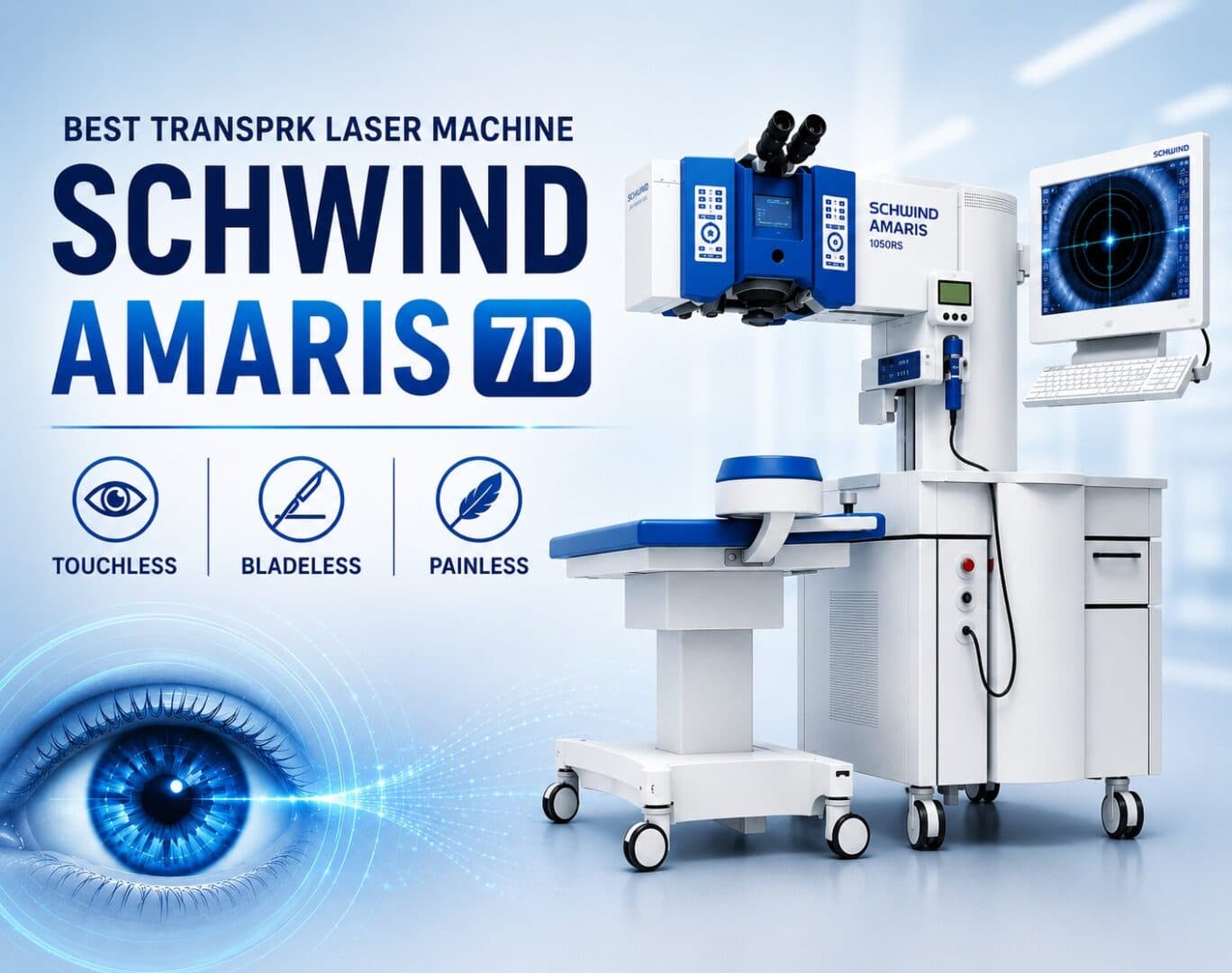
SCHWIND AMARIS with 7D Eye Tracking: The Best TransPRK Laser Machine of 2026
If you’ve been researching laser eye surgery in 2026, one name keeps surfacing across global ophthalmology forums, peer-reviewed journals, and patient communities — the SCHWIND AMARIS with 7D active eye tracking. Recognised as the best TransPRK laser machine of 2026, this German-engineered excimer laser is redefining what “touchless, blade-free, flap-free” vision correction really means.
At Netram Eye Foundation, Delhi NCR, we are proud to be among the select few centres in India offering TransPRK on this very platform — branded as our AI SmartSurfACE + CustomEyes Foresight 7D Laser System. Under the leadership of Dr. Anchal Gupta, patients from across India and abroad are choosing Netram for the safest, smoothest, and most precise specs-removal experience available today.
This guide breaks down exactly why the SCHWIND AMARIS 1050RS is considered the gold standard, what 7D eye tracking actually does, and how it translates into a better outcome for your eyes.
What Is TransPRK, and Why Does the Laser Machine Matter So Much?
TransPRK (Trans-epithelial Photorefractive Keratectomy) — also marketed worldwide as SmartSurfACE — is a next-generation refractive surgery that corrects nearsightedness, farsightedness, and astigmatism without creating a corneal flap (as in LASIK), without using a blade, without alcohol, and without any instrument ever touching your eye.
Instead, a single excimer laser performs the entire procedure in one continuous step:
- It gently removes the thin outer layer of the cornea (the epithelium).
- It reshapes the underlying corneal tissue to correct your prescription.
That’s it. No flap, no suction ring, no scalpel, no contact.
Because TransPRK is performed entirely through laser pulses, the quality of the laser machine is not a small detail — it is the single biggest factor influencing your outcome. Speed, precision, eye-tracking ability, pulse profile, and software intelligence all determine how smooth your cornea will be after surgery, how fast you’ll heal, and how sharp your final vision will be.
This is exactly why the SCHWIND AMARIS 1050RS has emerged as the global benchmark.
Why the SCHWIND AMARIS Is the Best TransPRK Laser Machine of 2026
The SCHWIND AMARIS 1050RS, manufactured by SCHWIND Eye-Tech-Solutions in Germany, is the highest-performance excimer laser currently available for refractive corneal surgery. Surgeons in more than 100 countries use the AMARIS family, and the 1050RS sits at the top of that lineup.
Here’s what makes it the undisputed leader in 2026.
1. Fastest Pulse Rate in the World — 1050 Hz
The “1050” in its name refers to its pulse repetition rate: 1050 Hertz, the highest of any excimer laser on the market. In practical terms, this means the AMARIS 1050RS treats each dioptre of myopia in just 1.3 seconds.
For a typical patient with -3.00 D and a 7 mm optical zone, the actual TransPRK ablation takes around 23 seconds per eye. Faster ablation means less corneal dehydration, fewer chances for eye movement to affect accuracy, and a more comfortable experience overall.
2. Ultra-Fine 0.54 mm Laser Spot
The AMARIS 1050RS uses a 0.54 mm Super-Gaussian laser spot — small enough to sculpt the cornea with micron-level precision, yet shaped to leave behind an exceptionally smooth surface. A smoother cornea after surgery means faster epithelial healing, fewer halos and glare, and crisper vision earlier in your recovery.
3. Industry-Leading 7D Active Eye Tracking
This is where the AMARIS 1050RS truly stands apart. While most excimer lasers track your eye in 2 or even 5 dimensions, the SCHWIND AMARIS 1050RS uses patented 7D active eye tracking that monitors and compensates for eye movement in seven separate dimensions — at 1050 times per second.
Even when you “stare straight ahead,” your eye is in constant micro-motion. The 7D tracker accounts for every type of movement that could affect laser placement.
What Are the 7 Dimensions of Eye Tracking?
| Dimension | What It Tracks |
| 1st & 2nd | Side-to-side and up-down movements (X and Y axes) |
| 3rd & 4th | Rolling movements of the eye |
| 5th | Cyclotorsion — rotation of the eye around its visual axis (static + dynamic) |
| 6th | Forward-backward movement along the Z-axis |
| 7th | Latency-Free Tracking — predicts and compensates for eye movement between image capture and the next laser pulse |
The seventh dimension — time — is the breakthrough that no competing laser truly matches. The system doesn’t just react to where your eye is; it anticipates where it will be during the next laser pulse and corrects for it predictively. The result: every single pulse lands exactly where your custom treatment plan intended.
4. SmartPulse Technology for Ultra-Smooth Corneas
Introduced by SCHWIND in 2015, SmartPulse Technology arranges laser pulses in an optimised geometric pattern, packing them more closely than ever before. This produces an exceptionally smooth post-operative corneal surface, which translates to:
- A “wow effect” — many patients report sharp vision within 24–48 hours.
- Faster epithelial healing (typically 3–4 days).
- Reduced risk of haze and post-op discomfort.
5. Intelligent Thermal Effect Control (ITEC) and Automatic Fluence Adjustment (AFLA)
Excimer lasers generate heat. The AMARIS 1050RS uses ITEC to actively manage corneal temperature during ablation, and AFLA to automatically calibrate laser energy in real time. Together, these systems prevent thermal damage and ensure every pulse delivers the exact dose your cornea needs — no more, no less.
6. Clinically Proven Outcomes
The numbers speak for themselves. Published clinical data on the AMARIS 1050RS show:
- 7%–99% of treated eyes achieve refractive accuracy within ±0.50 D of the target.
- Over 55% of patients gain one or more lines of Snellen vision after surgery.
- More than 900,000 SmartSurfACE TransPRK procedures performed worldwide as of recent reporting, validated across 40+ peer-reviewed publications.
This is why leading refractive surgeons across the world describe the AMARIS 1050RS as the safest and most precise laser vision correction platform available today.
TransPRK on the SCHWIND AMARIS 7D vs. Conventional LASIK: A Quick Comparison
| Feature | Conventional LASIK | TransPRK on SCHWIND AMARIS (7D) |
| Corneal flap | Yes | No |
| Blade or femtosecond cut | Required | None |
| Alcohol on cornea | Sometimes (LASEK) | None |
| Instrument touches the eye | Yes | Never — 100% touchless |
| Laser pulse rate | 200–500 Hz | 1050 Hz |
| Eye tracking | 2D–5D typically | 7D, latency-free |
| Suitable for thin corneas | Limited | Excellent |
| Risk of dry eye | Higher | Significantly lower |
| Risk of flap-related complications | Present | Zero — no flap created |
| Ideal for athletes, military, frequent travellers | Moderate | Highly recommended |
| Single-step procedure | No | Yes — epithelium + correction in one go |
Who Is the Best Candidate for TransPRK on the SCHWIND AMARIS 7D?
TransPRK on this advanced platform is especially recommended if you:
- Have thin or borderline corneas, where LASIK flap creation is not safe
- Lead an active lifestyle — sports, martial arts, fitness, dance, or travel
- Are in the military, paramilitary, police, or aviation services where flap risk is a concern
- Have dry eyes or are at risk of post-LASIK dryness
- Want the safest, lowest-risk form of laser vision correction
- Have a stable spectacle prescription for at least 1–1.5 years
- Are 18 years or older with healthy corneas (confirmed via topography, OCT, and pachymetry)
A detailed pre-operative evaluation at Netram Eye Foundation will confirm your candidacy with diagnostic precision.
Why Netram Eye Foundation Is Delhi’s Trusted Centre for SCHWIND AMARIS 7D TransPRK
Founded in 2013 and based in Greater Kailash-2, Netram Eye Foundation is one of the few eye hospitals in Delhi NCR offering the complete AI SmartSurfACE + CustomEyes Foresight 7D Laser System for TransPRK. We’ve combined world-class German technology with our patient-first culture to give you a refractive surgery experience that’s genuinely best-in-class.
Led by Dr. Anchal Gupta — A Senior Refractive & Cornea Surgeon
Our founder, Dr. Anchal Gupta (MS Ophthalmology, KGMU; brings over 19 years of expertise in refractive surgery and is recognised with multiple national and international accolades. Under her leadership, our team has performed touchless LASIK and TransPRK procedures on patients flying in from across India, the USA, Canada, and the Middle East.
Cutting-Edge Diagnostic & Surgical Ecosystem
At Netram, the laser is only one part of the story. The accuracy of TransPRK depends just as much on the diagnostics that feed into it. We use:
- High-precision corneal topography and tomography
- Wavefront and aberrometry analysis for CustomEyes Foresight personalisation
- Pachymetry and OCT for corneal thickness and structural analysis
- Zeiss and Topcon imaging platforms integrated directly with our SCHWIND laser
This means your treatment is mapped at thousands of unique points and translated into a fully personalised laser plan — your eyes, your prescription, your unique corneal anatomy.
Patient-First, Transparent, and Accessible
- Cashless mediclaim with all major insurers and TPAs
- Empanelment with major government schemes
- EMI options and clear, itemised pricing — no hidden costs
- Free pre-LASIK consultation to confirm candidacy
- A welcoming, multilingual support team that walks you through every step
What to Expect: Your TransPRK Journey at Netram
- Free LASIK / TransPRK consultation. Comprehensive eye exam, prescription stability check, and lifestyle goals discussion.
- Advanced diagnostics. Corneal mapping, topography, OCT, pachymetry, and aberrometry — the data is uploaded directly into the SCHWIND CAM treatment planner.
- The procedure. A 100% touchless, single-step laser treatment. Most patients spend around 5 minutes per eye under the laser. No injection. No flap. No bandage.
- Bandage contact lens. A soft, protective lens is placed on each eye for 3–5 days while the epithelium regenerates.
- Recovery. Many patients see clearly within 24–72 hours and achieve their final vision over 2–4 weeks. Eye drops are used for several weeks to support healing.
- Follow-up. Scheduled visits at day 1, day 5, week 2, and month 1, with 24×7 access to our team for any concerns.
Frequently Asked Questions
Q1. Is TransPRK on the SCHWIND AMARIS painful? The procedure itself is painless — performed under topical (eye-drop) anaesthesia. You may experience mild irritation, watering, or a foreign-body sensation for 2–4 days during epithelial healing, well managed with prescribed eye drops.
Q2. How long does the actual laser surgery take? Around 5 minutes per eye in the laser room, with the actual ablation taking only 20–30 seconds in most prescriptions. The full appointment, including preparation and post-op briefing, lasts about 2 hours.
Q3. How is TransPRK different from LASIK and SMILE? LASIK creates a corneal flap. SMILE creates a small lenticule that’s removed through a tiny incision. TransPRK creates nothing — no flap, no incision, no instrument touches the eye. This makes it the safest option for thin corneas, dry eyes, and active lifestyles.
Q4. Is the SCHWIND AMARIS available in Delhi? Yes — Netram Eye Foundation in Greater Kailash-2 offers TransPRK / SmartSurfACE on this platform with full 7D eye tracking and CustomEyes Foresight personalisation.
Q5. What is the cost of TransPRK at Netram Eye Foundation? LASIK and TransPRK packages at Netram start from competitive price points and vary based on prescription, customisation, and pre-op evaluation. EMI options and cashless insurance are available. Book a free consultation for an exact, itemised quote.
Q6. How soon can I return to work after TransPRK? Most patients return to desk work within 4–7 days. Outdoor work, gym, swimming, and contact sports can usually resume in 2–4 weeks, as guided by your surgeon.
Q7. Will my vision be permanent? Once your eye prescription stabilises after surgery (typically within 2–3 months), the results are designed to be long-lasting. A small percentage of patients may experience minor regression over years, which can be addressed if needed.
Q8. Is TransPRK approved for defence services and government jobs? Yes. Because there is no flap, TransPRK is widely accepted by the Indian Armed Forces, paramilitary services, and most aviation/defence selection boards. Always check the latest service-specific requirements before applying.
Step into 2026 with the World’s Best Laser — at Netram Eye Foundation
Choosing your laser eye surgery centre is really about choosing the team and the technology behind your eyes. With the SCHWIND AMARIS and its 7D active eye tracking, you’re choosing the most advanced TransPRK platform on the planet. With Netram Eye Foundation, you’re choosing a team that has built its reputation on ethics, empathy, and excellence — with a founder whose surgical hands and patient-first philosophy have earned global trust.
It’s time to step out of glasses and step into clarity.
Book your free TransPRK consultation today. 📍 Netram Eye Foundation, E-98 Greater Kailash-2, Opp. GK-2 Gurudwara, New Delhi — 110048 🌐 www.netrameyefoundation.com 📅 Online appointments and video consultations available.
Because at Netram Eye Foundation, every eye deserves the world’s best.